Take Big Swings and Care a Lot: A Review of Control Resonant
Control Resonant is the newest game by Remedy, but does it surpass Control 2019 and Alan Wake 2 or does it simply falter?

Hello / Greetings / Goodbye
I am one to appreciate an "art film", I like media that takes chances and swings for the fences even when it does not always land. I enjoy art that pushes the boundaries of "reasonable" and decides, "nah fuck it, these limits suck, let's do something else entirely different" over and over again.
I love A24 films, I love progressive rock and math rock, I love bullshit that maybe does not always make sense but finds a way to hit you right in the Kingdom Hearts.
It is in that sense that I truly loved Control Resonant.
My history with Remedy could be best described as rocky. I did not grow up playing any of their games (not even Max Payne though I was aware of it), and when I finally played Alan Wake 1 a few years ago I bounced off, hard. It should have been the perfect game for me. I love Twin Peaks (mostly season 1) and I love a good detective story, I love horror films, and the north west is a gorgeous part of the United States I have never been to but would love to see some day.
But the combat was janky, the battery mechanic with the flashlight sucked, I remember I got bugged and stuck in a corner when I deigned to do some exploring in a promising part of the map. I had just had enough and I quit.
But flashback to 2019 and Control came knocking at my door. I answered a bit nervously, but IGN and other outlets were very positive. People were talking about it being a huge hit and it got some GOTY nominations and awards too. So I gave it a shot and I thought it was...great! A bit confusing at times in the navigation, but I loved the combat, thought the aesthetic was undeniable in how good it was. The brutalist architecture, the use of colors, the character models and particle effects.
But like I said, it was just great. I did not go to my proverbial window and telekinesis a bit of convenient rubble onto my nearest street with screams of how amazing it was. At the same time, it pried the door open a bit more for me to be open to Remedy in the first place so that I would eventually try Alan Wake 1, Quantum Break (good game!) and be interested in Alan Wake 2.
Then I tried the Control DLC that was supposed to tie right back into Alan Wake 2 and hoo boy I did not have fun. I thought the enemies were way too hard and the navigation was ridiculous nor was I invested in the plot at that point.
But Alan Wake 2 is the game that made me a full on convert. A self-obsessed writer who is a bit narcissistic, self-hating, and loves to speak in the third person, now that's someone Dory can get behind!
Ahem.
In all seriousness though, much improved combat, a tighter narrative and navigation made much simpler with amazing dance numbers (no, really) and some fantastic set pieces plus the continued building of the Remedy Universe.
Oh yeah, it was all coming together.
That all paved the way for Control Resonant.
Let's get into it.
This is Foundational / Baseline / Guitar Solo
Control Resonant takes place 7 (seven) years after the first game, so in real time, basically. Which, I feel like that may got understated in reviews, that is in of itself a pretty big risk to take. How do you account for all of that time passed? What has happened to these characters? How do you make them look like the same characters we knew and loved (or hated) 7 years ago but still different enough to compensate for that time period?
Well, basically Remedy said, "fuck it, COVID was so fun let's just impose it on our characters". And so that's what they did as The Oldest House went into lockdown for 7 long years while Jesse Faden did her best to contain The Hiss.
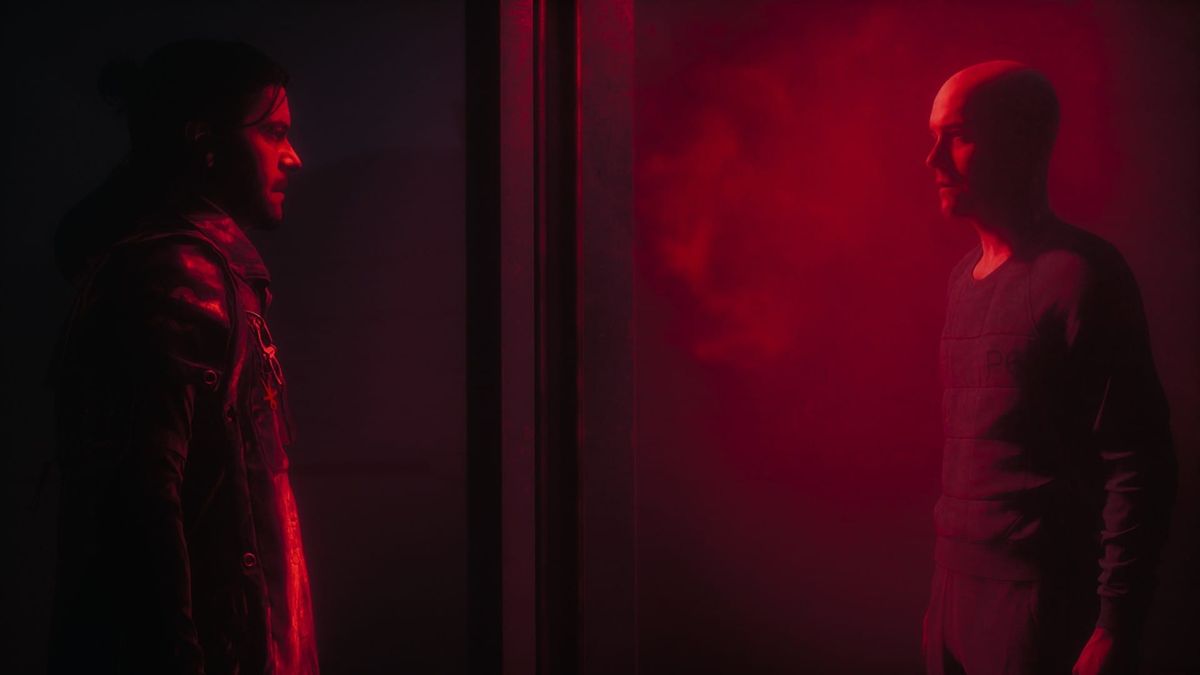
But the lockdown suddenly ends when Jesse leaves, her brother, the antagonist of the previous game, Dylan (recipient of the "I killed 536 people without breaking a sweat and all I got were these lousy clothes" award) wakes up and The Hiss break free onto an unsuspecting Manhattan, leaving the entire area closed off.
This is where you, Dylan Faden, come in.
Much like a lost puppy (credit to Jack for the puppy imagery), Dylan has been in a coma for the past 7 years too. He's suddenly a 34 year old man who has minimal social skills, even fewer academic achievements, but a whole lot of power. The Board (which constantly / always / never, talks like that) has infused itself with his main choice of weapon: The Abberant. You can get dual wield some knives, use a big get the fuck out hammer, or go for a glaive that hits everyone in a 3 mile radius.
Initially I went for the knives, before I changed to the glaive under the recommendation of some fellow players. I loved the critical damage you got from the knives and how personal the attacks feel, I also love playing as a rogue, so for me it felt like a natural fit. I made my finish combo a wide sweeping attack to make up for my lack of range with my main combo and got a shield formed of rocks for good measure, after all, the best offense is a good defense, right?
Wrong!
The game literally tells you in the loading screens (these still exist??) that the best offense is a good offense, you absolute buffoon. You dunce, you neanderthal!
No, in Control Resonant you need to stay on the attack. Killing enemies (more so the smaller ones) is how you get health back. Sometimes there are some small health orbs in the environment but that's uncommon and not a reliable way to stay in the fight. Instead, you need to kill a lot of small enemies, or hope a big enemy is going to give you some health after you wack it a bunch of times.
IGN said in their review that "Combat's sharp edge eventually gets dull..." and while I can see where they're coming from (this is easily Remedy's longest game at 30+ hours!) I personally never felt that way to any significant extent. The ability to always mix up your combo finishers via The Gap (the metaphysical realm in Control Resonant, not the store), if you get enough of the right kind of resources you can switch to the hammer (I never did this) or the glaive if you pick the knives and vice versa. There are also plenty of combat abilities I enjoyed that gave me long-range capabilities, as well as the rock shield which proved invaluable.
Overall, the combat is a sincere highlight for me. I have heard it said otherwise but let me back it up: This is the best combat Remedy has ever done.
Is it perfect? No. Sometimes you lose altitude in the middle of a combat, Dylan hitches, your drill does not extend as far as you think it should and you may as well just be tickling one of The Hiss with a tuft of thistle or some bullshit. Sometimes enemies can stunlock you in the air or on the ground and at times I yelled "DYLAN PLEASE MOVE YOU ARE GOING TO DI-" before promptly dying.
On the whole, however? Very good!
This is Aesthetic / Crucially Artistic / Actually Awful
Now, I might claim to love art but do I actually understand art? At 35 years on this earth (god, I'm old), I feel like I should. Yet the fact that my favorite paintings have been and continue to be the most non-abstract, semi-realistic, oil paintings you have ever seen, probably means Control Resonant and I were always gonna bump into each other hard at some point or another throughout our time together.
My biggest criticism with this game is the same I would levy at arthouse film, or some forms of experimental music, or the paintings and participatory art forms that just do not seem to go anywhere. I remember going to a Museum of Fine Arts showcase all about gender, dress, and how the two intersect and fall apart. I could not have felt much less seen, more alienated, or at all less impressed. I did not see what the exhibit wanted to express, found the whole thing vaguely annoying as someone who does not get (nor wants to get) "fashion" and thinks that clothes should be, first and foremost, about comfort and self-expression.
Everything else is secondary.
Unfortunately, Control Resonant is a bit like that art exhibit at times. I struggle to understand what exactly is happening, why it is happening, and what I can exactly do about it. The director of the game Mikael Kasurinen said about the game:
It’s so important that the players feel like they’re the ones figuring it out ... It’s the job of us as creators to… I mean, it is a crafted experience at the end of the day, right? You have to find the right balance between ‘here’s the world’ and ‘here are the different themes and elements that you have to pay attention to.’ But it has to feel like it’s on you to make a decision on what to do with those elements that you see within the world. If it feels like it’s like ‘go here,’ it’s not anymore a decision for the player. Somebody already decided for you. -Dropped Frames
Of course, we all know what Kasurinen is speaking of when he says "go here" and the players have less agency. Whether he intends to or not, he is evoking the type of game that Insomniac just released with Wolverine and the infamous fart trails.
Yet, on recent episodes of the podcast with Seb, we have argued against the idea that it has to be one way or another. You can have accessibility toggles, you can design your game to be accessible without making it too hand-holdy, you can have a little yellow tape without making your entire world yellow.
In other words: There is a happy medium.
Control Resonant falls more on the side of putting yellow tape in the background, praying you'll notice it, and then not caring particularly if you do or don't. In that, there's no follow up from characters, from tutorials, from the environment, there's simply signposts that are minimized in a sea of ephemera and collisions, particles, affects, and minutiae that gets lost in a sea of whatchamacallits.
I'm not going to pretend I am some kind of savant when it comes to directions. I have spoken multiple times on the podcast with Seb that I get lost fairly easily both in real life and in video games. But even my cohost complained to me in our DMs about how he was struggling with puzzles, with the world map, with navigation. In which case, I know it is not me. Another friend of mine who absolutely adores the game also admitted to me that he got lost in a side quest for 2 hours.
Look, there has to be a fine line here.
At some point you make me beg for some far gas, some Dead Space lines I can get from the analog sticks, a compass, a (better) map, a marker, something!
Instead Control Resonant just kinda looks at you and says "but look at all the freedom you have!" The freedom to get lost and discover on your own is a nice one to have, but it is tiresome when it never feels like you are making tangible progress on the things you care about. It becomes an arduous task of trying to filter through everything in the environment and wonder how important it is or is not, whether it is related or unrelated, or if you're just lost, and to me, that's not a freedom I find particularly valuable. It's a freedom that feels like it needs to be reined in.
That's not to say the world map, mini-map, navigational style, has no merit to it at all. The custom markers look just like the NYC subway numbers and as an autistic person I am legally mandated to respect and appreciate that. The map itself on the broad scale is clear and distinct, it's when you get to the actual design of the environments that you run into issues. I'm right on top of the market, is it above me or below me? Is it in some kind of other space? Have I already been here?
This problem was especially note-worthy in the last two major sections of the game where I kept backtracking, front-tracking, hell, at some point I even sidetracked, wait no, shit, that's a thing, never mind. I thought I was being clever.
Regardless, it feels like this game could have used more fart gas.
Just a tiny bit.
Redemption Song / Don't Call it a Come Back / Please Come Back
There is a lot of discussion right now about what it means to redeem yourself after truly heinous actions. I do not have much to add to that conversation, both because I feel ill equipped, and because of whatever biases I have likely limit how useful my input would be.
What I will say is that Control Resonant also grapples with this. Dylan Faden killed over 500 people, yes, he was not in control of his body, yes he was brutally controlled and abused as a child by the Federal Bureau of Control, but as Dylan himself says, it was ultimately him. He let The Hiss in, he let them in so that he could have a better chance of being free after being imprisoned for so many years, after being abused for so many years, neglected and isolated by them.
Is that right? Is Dylan redeemable? I don't know.
What I do know is that as you get into the story you find out that Dylan is a talented artist, he wants to learn about music, he loves video games (what a fucking nerd!) that he does his damned best to make up for his sins, that he wants to help and actively puts his life on the line time and time again to regain the trust of those around him. And still, sometimes it fails. People tell him to go to hell, say he's the devil himself, call him out for his past actions 7 years ago, and then some.
He's constantly derided by those around him, questioned by his handled, has a neck bracket that will kill him if he steps out of line and is verbally spat on often.
There is a scene in this game that stuck with me though.
It's a small scene, it doesn't mean much in the broader story, it's not even a main quest, it's a side mission amongst many other side missions.
But a character says, after Dylan says he has a lot to make up for:
There's no making up for mistakes. You just gotta learn from them and do better next time.
I have never been so struck by such a simple quote on such a complicated subject.
The writing, since I have not mentioned it up until now, is largely fantastic. Some outlets have argued that Dylan and Zoe's relationship feels forced at times, but I generally felt like it moved at a respectable pace and I understood how they were able to connect as agent and handler. But either way, this quote stands.
How could Dylan possibly make up for killing over 500 people? What would that even look like? Would he have to go to every single grave and say grace? Go to every family and personally apologize? Donate $536 dollars to a local charity of each individuals families choice? What does redemption even look like in the wake of such an awful action? Again, I don't claim to know, and I don't think Remedy does either, it doesn't even try to, it just shows us what you have to do: Live.
You have to give every fucking inch of yourself to learning, doing better, and making sure you don't repeat the same mistakes over and over again. Even if everyone hates you, even if they think you're a monster, even if nobody believes a damn word you say about your experiences. No matter what, you have to give a shit. You have to care a lot and it's going to hurt and it's not going to be easy.
You're going to lose people along the way, you're going to make more mistakes, some of them may be worse in a different way, some of them may be "better" but they will happen all the same. Sometimes you really fuck up and whatever happens as a consequence is probably what you "deserve", for whatever that is worth. But you just have to keep picking yourself up and doing your best to be better. You cannot do anything else because to do anything else is to give up. It's to become lost in your own despair, hopelessness, and simply accept what others say.
Dylan Faden shows throughout the excellent storytelling in this game that we do not just have to be our pasts. We do not have to let ourselves fall victim to the public perception of that. That we can risk ourselves, our life, and our very existence and give it to this world as a gift, for the risks it takes on us. Maybe that doesn't "make up" for the harm done, but it's a good start, it's something, if nothing else, it's better than the alternative of giving up and not risking anything.
And I'm glad I took the risk on Control Resonant, it paid off.
Rating: 4.5/5 or 9/10.